

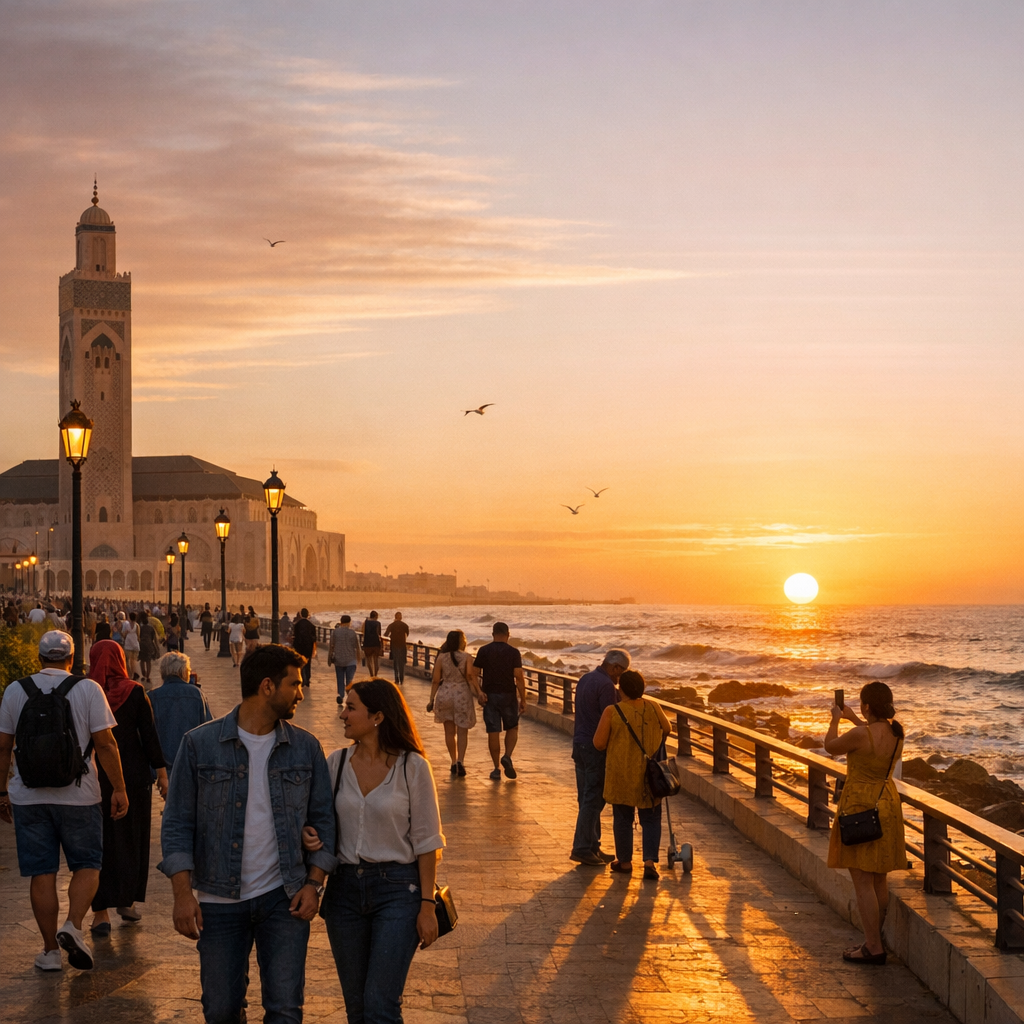
Casablanca’s Maritime Promenade near the Hassan II Mosque stretches for about 1.5 km along the Atlantic, opening up 13 hectares of public space to waterfront views, walkways, shaded rests, and informal conversations. Designed not just for ocean lovers, this promenade has become one of those rare spaces where daily life shifts slightly—where people from different walks mix, where the city feels a little more human.
A Moment to Breathe
In a fast-moving city like Casa, the time to simply walk, pause, watch, or listen can be rich. Kids chase seagulls, couples stroll after dinner, elders sit by the sea wall sharing stories from the old city. Joggers pass through, cyclists skim past, all under palms that offer relief from the sun. It’s not just about design—it’s about the calm that permeates, a contrast to the congestion just a few blocks inland.
Born From a Need for Public Ground
This promenade is part of efforts led by Casablanca Aménagement and the local municipality to strengthen public spaces across the Grande Casablanca region. The goals are clear: improve quality of life, foster social cohesion, and invite the city’s many voices to share in its public life. The promenade includes kiosks, benches, sports nodes, shaded stretches, and accessible walkways—all created to encourage people to reclaim what public space offers.
Spaces That Reflect Us
For many residents, especially those from districts like Ben M’sik and Sidi Moumen, this public space signals possibility. In Ben M’sik, for example, a community museum has been working to capture stories of migration, craft, and memory—efforts that mirror the promenade’s approach: that public life matters. In Sidi Moumen, initiatives like the IDMAJ Foundation cultivate youth leaders, offering creative and civic outlets in places where options have often felt limited.
Remaining Shadows in Common Ground
But the promenade also surfaces challenges. People still worry about safety after dark; infrastructure like lighting and maintenance in less central sections lags. Accessibility for those with disabilities or fewer resources—farther from transport hubs—remains uneven. For some, the price of reaching the space, whether by bus or taxi, adds a barrier.
Why It Matters Beyond the Waves
This promenade is not just seaside scenery—it’s civic terrain. It holds potential for dialogue, inclusion, shared experiences. It’s where a child from Hay Mohammadi can play, where someone from Casablanca’s older families can remember, where young artists can sketch the horizon. As the city grows and remakes itself, spaces like this are anchors—reminding us that cities are made not just of buildings but of breath, gathering, storytelling.
Casa’s Maritime Promenade is a step toward something collective. It won’t fix everything—but it opens a door. And in a city of many voices, that door is worth walking through.